
Yes, you can speak Latin, and here is why GCSE and A-Level students should

Updated: Apr 30
I want to show you how to make Latin make sense. I will start with myself: I keep my Latin sharp by speaking it regularly (yes, people do speak Latin!) and reading and writing in it. My students enter a world where Latin is alive, useful and easy to understand, which helps them ace their exams.
Not convinced? Let me tell you a bit more about it:
On not needing to be an analytical genius
You may have heard that in order to learn Latin, you need to be a genius: the subject is reserved for logical minds able to decipher the complex puzzle that is Latin. The reality, however, lacks much of that mystique. By all means, analytical skills are needed for grammatical analysis, but access to the language can take many paths.
My journey to Latin-speaking
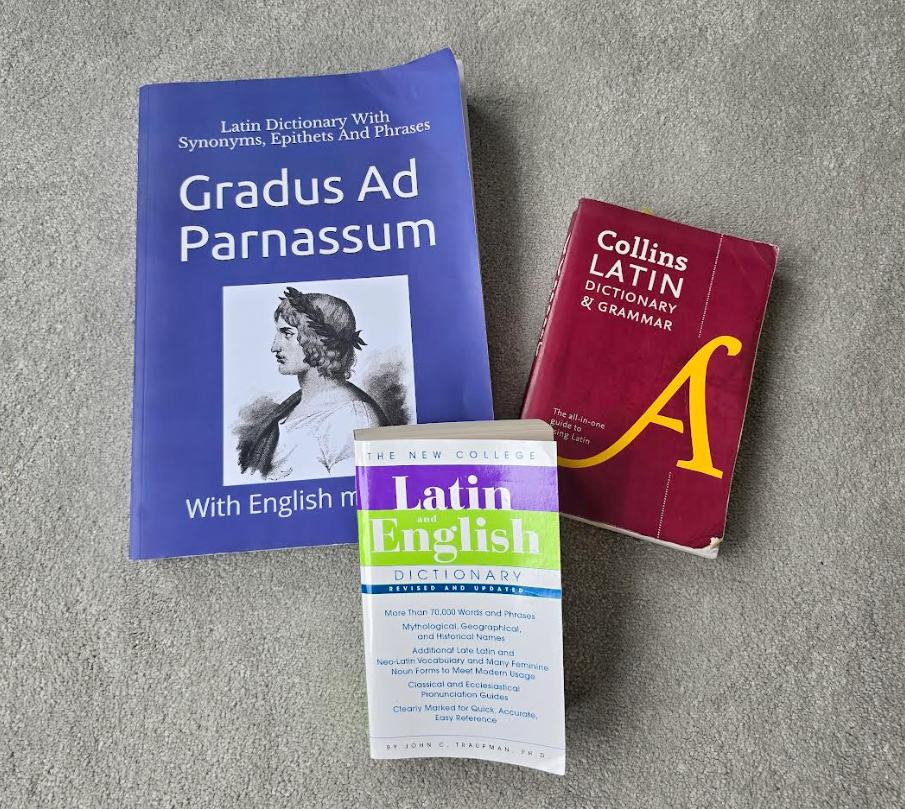
I went through the usual grind at university to be able to translate Latin literature, and I carried a dictionary everywhere, and I really mean everywhere, including unseen exams. Actually, in the case of Greek, I carried two dictionaries. Why? Because I loved the Bailly dictionary, but it was in French, and I was too paranoid that I would not understand a key French word and make an error in my translation. I was pretty good at languages, but Latin and Greek were an effort.
Ah! The irony: after five years studying Classics at university, I had managed to improve my French to proficiency, learn English to a reasonable standard and pick up German from scratch, ready to move and tutor in Germany. Yet I was still carrying a dictionary everywhere and "looking for the verb" and "checking the agreements" in Latin and Greek texts.
It is no wonder that, after my first teacher placement and despite my unwavering love for classical languages (after all, I could "read" them at a reasonable speed and with reasonable accuracy), I decided to switch to teaching English, German, and French.
The reality is that teaching Latin and Greek was fun (at least for me), but for many students it was a grind involving cryptic tables and syntactical intricacies and, nearer the exam, a preestablished selection of, to some, incomprehensible passages by Caesar involving the annihilation of some unfortunate tribes. I had enjoyed linguistics greatly at university, and I am still fascinated by the structure of language, but it was, to say the least, frustrating not being able to enjoy a laugh and a good read in Latin and Greek as I was able to do with the other languages I spoke.
You would think something would have clicked at this point, making me reconsider my approach, but it did not. It may come as a shock to hear me say this, but I will: I still thought speaking Latin was pointless. In fact, it started to look like I would not go back to teaching Latin, seeing how much fun English and German were, with all the singing, movie watching and, my absolute favourite, language exchange meetings, which were my main hobby in my early twenties and have given me friends that I keep to this day. But more on that later.
Speaking Latin: a pointless gimmick?
As I was saying, I thought speaking Latin was a gimmick and actually looked at those who said they could do it with a bit of suspicion:
Had they translated it all beforehand?
Could they really hold a fluent, improvised conversation?
Note that this was all before the boom in social media, so I did not actually know any Latin speakers, let alone Greek speakers!
So I ended up taking a break, travelling the world, becoming a diving instructor and, in a rather unexpected turn, meeting Will Griffiths, at the time a representative for the CLC, at a fair for language specialist jobs. I had just moved to the UK and was quite interested in returning to teaching, so I applied for all manner of jobs and decided to include Latin because Will had told me there was strong demand for it (thank you, Will!). And indeed there was: a couple of weeks later, I was working at a school and doubling down hard on my CPD, which was to prove the turning point in my journey as a Latin teacher (and learner!).
It took 45 minutes on a random Saturday morning CPD session for me to upturn the way I was teaching and learning. 45 minutes with a secondary teacher, Keith Rogers, whom I thank every time I get the chance to, demonstrating how to use the language in class to make it comprehensible and get students to use it actively to understand it better. Yes, like I had been doing all along when teaching German, French and Spanish!
What followed was a gradual introduction of living Latin into my classroom, which took quite some time because there were exams, life and even two children in the way! Luckily, the internet helped me learn from some of the best active users of Latin, and I learned (and am still learning) from an amazing cast of teachers, including Irene Regine from Satura Lanx, the amazing tutors at Latinitas Animi Causa and the dedicated members of Cultura Clásica and the Scholae Cantabricae.
The result? I can now sit down, pick up a Latin book I like and read. Simple, yet out of reach for so many students let down by a system that prizes memorisation and strict accuracy over communication. Translating is very different from actually knowing a language.
I can also walk around town with friends while having a chat in Latin, keeping alive more than two millenia of human interaction and driving it further into the future. In a way, I am in my early 20s again! I have even become a member of the Circulus Latinus Londiniensis, which was certainly not on the cards when I moved to the UK.
I would love to say that I teach fully in Latin, but the reality is that UK exam system just does not allow this. As I showed when I spoke recently at the University of Cambridge's Comprehensible Input in Classical Languages Conference, the focus on translation in exams means that we need to compromise. For my part, I do this by including a prominent verbal and aural approach around translations, and making sure that ouput (speaking and writing) is not fully overshadowed by the necessary preparation needed for translation exams.
Why language proficiency requires speaking and writing
I could go into all the research and evidence, but really the question ought to be how did we get into the mess of treating Latin like a puzzle in the first place.
It is beyond the scope of this short blog post to examine the history of language teaching, but a short overview might help: grammar-translation methods are called traditional, but they are in no way how Latin used to be taught when people managed to, well, actually learn it. This was the case all the way through the medieval period and the Renaissance, when Latin was still learnt as a language for communication, and only started shifting after the post 16th century pursuit of classical purity and standardisation driven in great part by the Jesuits. To summarise it, we could very simply put it as a matter of sophistication and intellectual rigour over actual interest in efficient proficiency.
I fell for this. I used to think that studying Latin was great because, being dead (oh dear!), it allowed us to focus on its structure and gain insights on the linguistic possibilities of the human mind together with an understand of the history of the linguistic development of Europe and beyond.
9+ languages and 20 years later, I realise now how wrong I was: by all means, studying historical linguistics, morphology, syntax and so forth is an amazing pursuit, however one is neither fully learning Latin nor finding in Latin anything that cannot be found elsewhere.
Latin is not special, as much as I love it. I have had great insights into linguistic typology by learning Mandarin or Arabic, and I could have gained those insights from any combination of languages, not only Latin.
So what is unique about learning Latin?
Its literature across a span of more than 2000 years. A living tradition in which we can still engage.
But I digress:
Let us return to the role of speaking and writing, and why I think it is the key for students to gain proficiency:
It is the perfect retrieval practice and the best way to consolidate what is being learnt
It allows the speaker to notice gaps in knowledge and negotiate solutions to fill them
You start to think in Latin and stop translating, reducing the cognitive load and allowing for immersion and a state of flow that fosters acquisition
It is meaningful and engaging, and as such will be remembered as useful
I could go on, but the bottom line is that languages are naturally learnt by and for communication.
How can GCSE and A-Level students bring Latin to life
I have spoken in another blog post about the impact that using the language orally has on the learning process, so here I am going to focus on A-Level.
Ideally, students should start engaging in Latin speaking from the very beginning, but this is not always possible. However, it is never too late for it to have an impact, and a student starting in Y12 can hit the ground running in Y13 ready for Oxbridge application and, ultimately, the final Unseen Translation and Prose Comprehension papers (more on those in my A-Level exam content analysis).
Here are some tips to get started:
Make you not only read but also listen to texts, and read them aloud even when alone.
Find opportunities to speak Latin. Ideally you will do this with a teacher, but if that is not possible, you can always find free resources from YouTube to dedicated websites.
Read easier dialogues, like the ones from the Colloquia of Familia Romana
If you would like ongoing support including workshops to bring Latin to life, my A-Level membership is now open for registration. You can find out more about it here:


Comments