
Nolan's Odyssey Movie vs. Homer's Book: Why the Epic Belongs to Nobody


July 2026 has been my favourite month on record for Classics in mainstream media. Everyone, and I really mean everyone, has had a go at dissecting Nolan's epic The Odyssey.
I am not going to write today as a Classics teacher, but as an avid reader and moviegoer, though I will put on my classicist hat where it is relevant.
If you are here to try to find out how the movie differs from Homer's book, you are not quite in the right place... instead, you are in a better place: it is far more interesting to explore intertextuality than to play "spot the difference".
What makes a good adaptation of a book (even though "The Odyssey" is not exactly a book)
Much of the criticism of Nolan's movie has been related to accuracy. But does it matter?
First, this is misplaced: Homer's version of the Odyssey is itself a product of centuries of oral tradition, written down in a language that was never really spoken in that form, and showing a world that goes beyond one particular historical context. This is the essence of traditional epic poetry, and a great part of its allure. The world of Odysseus was never real.
Second, the story of Odysseus exists beyond the epic compilation that we call Homeric. The Odyssey also exists in art and in later interpretations. Without going too far, the very story of Sinon, which is so prominent in the minds of readers of classical literature, follows the account, albeit with a new perspective, in Virgil's Aeneid.

If accuracy does not matter, what does matter when bringing a classic to the big screen?
A movie cannot—in fact should not—try to recreate a book exactly as it was first written: this would be a rather dull attempt, and not quite worth it, in my opinion. And so, Nolan had to renew the Odyssey for the people who would sit in theatres all across the world, each with their own desires, biases and expectations. Not everyone is going to like it!
What makes a good adaptation is great cinema that invites you to see the story in a different light. Like Uberto Pasolini's The Return, Nolan's The Odyssey has achieved this very well. This is evidenced by the impassionate debate it has triggered.
Does the script need to be faithful to original texts?

Would I have preferred Nolan to use more of Homer's text? Probably. But equally, I was delighted to see other intertextual references. And, as I mentioned before, there are many Odysseus(es) in the literary and artistic tradition, and they are all, to put it bluntly, fair game.
Some adaptations keep the original text, and play with the visuals, performance, and setting. This is easy to pull off when the original is a play in the first place. Turning an epic poem or a novel into a script is quite different.
Some adaptations keep more of the original setting but play with the plot, characterisation and themes, as Nolan has done. This is not a crime against the literary tradition, rather precisely what we have been doing with canonical literature for more than 2500 years.
Think about Greek theatre, for example: the point of view from which Euripides presented the Trojan Women was revolutionary. The Odysseus in Sophocles' Ajax is also somebody different from Ajax in the Iliad.
Moving on to Roman times, Virgil took up the flame, and his Aeneid is firmly rooted in Homer while speaking to Romans who were entering into a new political contract and needed to reflect on peace, fatherland, love and duty. Ovid turns Penelope's frustration into a bitter letter in his Heroides, and the recycling continues all the way to Atwood's Penelopiad and even, trust me on this one, Finding Nemo: why would he be called Nobody otherwise?

Is Nolan's Odyssey the best Odyssey movie adaptation so far?

This is a very difficult question to answer given that I—I must confess—am a great admirer of Matt Damon. Give me Matt Damon trying to get back home, and I am bound to enjoy the journey. Jokes aside, my overall answer is still "Yes": this is the best Odyssey adaptation I have seen, and it is a great movie too!
Now, is this the best movie of a classical theme out there? The answer is a definite "no". There is a long tradition of what was once called the "peplum" or "sword-and-sandal" genre (now often called action movies), and some of the movies are masterpieces. Nolan's Odyssey is competing in a surprisingly empty category, as there are not that many films presenting themselves as a full Odyssey.
There is a limited list of Odyssey movies; in fact, if you exclude those that focus on the Trojan War or Greek mythology more broadly, such as Troy, or a looser connection to the text, such as Brother Where Art Thou? As examples on both ends of the spectrum, we have the 1997 miniseries, which was hardly groundbreaking, and 1989 Nostos: Il Ritorno by Franco Piavoli, which is a great work of visual art and a symphonic achievement, but is so agonising that I am not sure most people would watch it more than once.
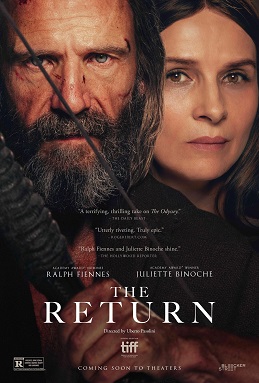
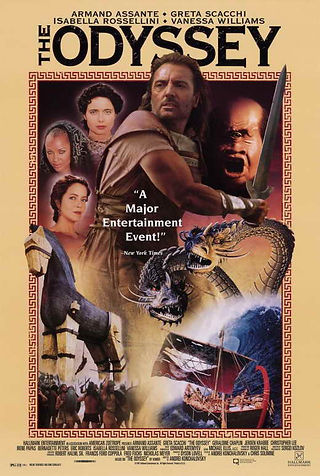
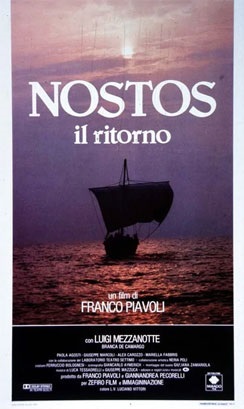
You will probably wonder what I think about different elements in the movie. A proper dissection of the film would take more than a blog, but below are some of the aspects I found remarkable (one way or another):
A look at Nolan's choices
Trojan horse: why did Nolan change Virgil?


If I had a pound for every time I have read that the horse should not be standing up!!! This is very indicative of much of the criticism the movie has received. While it is true that the Trojan horse has traditionally been depicted with feet on the ground, the rearing horse is a cinematic triumph.
The horse places the audience in the driving seat and reclaims the Odyssey for the big screen. The allusion to Planet of the Apes is inescapable for any film lover, and it encapsulates the themes of war, return and realisation, leaving viewers who had come to watch an epic film in the middle of a frustrating tragedy.
Upon seeing the horse, the audience is invited to open up to new versions of the Odyssey. And this does not take long to come: the many docti poetae sitting in the audience and waiting for divine intervention will soon realise the gods are not going to be driving the plot: this is for the most part a self-inflicted tragedy.
The cast: a black Helen, Jason Bourne as Odysseus and a Telemachus from Kingston upon Thames
The talk about the casting made me, want to retreat from human society at times. In a story where somebody is born out of a swan's egg, and a man can have 50 sons and 50 daughters (a bit more realistic, but still), the expectation that the cast for a story more than 3000 years in the making should be drawn specifically from the modern geographical area of Greece is absolutely astonishing.
Lupita Nyong'o and the rest of the actors deliver a top-class performance, and the presentation of Helen and Clytemnestra as identical twins is, at the very least, thought-provoking.
The silent encounter with the Cyclops
This was a difficult scene to watch. No "nobody"? Why? I do not know. Perhaps because this is not the wily, boasty Odysseus in Homer. Perhaps because the aim was the darkest pit of fear and dehumanisation. Perhaps because the visual reference to Goya was to be savoured in full?

The latter would make sense: Goya's painting, Saturn devouring his son, does not serve only as a visual anchor. It reminds us of the traditional understanding of the myth that Goya was thinking about: all-consuming time. This fits in with the exploration of time and memory that the stay with Calypso effects in this version of the myth. However, there is a third option.
What if the conversation never took place? After all, the Phaeacians have been left out of the movie altogether, and this episode is one that Odysseus explains to them in his own words. If the Phaeacians are erased, what we have is a different Odyssey, a stab in the dark at what happened led by Odysseus's post-traumatic flashbacks: no embellishments, no kleos to be gained, and a nod to the fatherly duties Odysseus seems to be flaunting.
The peoples of the sea
A part of me wonders if the whole "people of the sea" and "end of the Bronze Age" motif can be as simple as it looks. It perhaps is. Not everyone in the audience will be an expert on the Bronze Age collapse, and it is an interesting interpretation to view the levels of destruction as self-inflicted, tying in nicely with the allusions to Planet of the Apes. This was probably one of the elements of the movie that broke the magic for me, as it stood out in an otherwise careful ahistorical narrative.
The fate of the maids
Before I wrap up my review, I must admit that there was one choice that did not sit right with me: the treatment of the maids. In Homer's Odyssey (and Atwood's Penelopiad in particular), the maids hang as we wonder about justice, equality and humanity. In the film, the revenge of Odysseus felt flat and superficial.
It does not escape me that I have written the whole review asking others to manage their expectations, yet I am now asking for a very particular scene in Homer to be part of the film. As I sat in the cinema, I watched a traumatised man deal with his own path to success, and I naively expected the plot to reflect what for me are the concerns of the modern audience: gender and wealth disparities, political change in new economic circumstances and moral contradictions in our global society. Instead, what I got was a focus on the laws of xenia with a touch of hybris. But I have said before that versions do not need to be what we expect them to be, so I will just accept it and hope that I can get more from the main themes in my next viewing. I will update the blog then!
Why the Odyssey still matters

The best to come out of this movie, for me, has been seeing Homer and its reception on the front pages of newspapers around the world. Amid a downward trend in funding for education in the humanities, it has been a beautiful irony to confirm that we all live from stories, and the richer the background, the better the conversation. May more Odysseys be created and may stories keep delighting us with shock, awe and inspiration.
If this post has inspired you to learn more about classical civilisation, languages and reception, make sure to follow me on Instagram for more!


Comments